Laminate vs acrylic vs PU: which shutter finish goes where, and what it costs.
Use laminate for wardrobes, lofts and any kitchen with children in it. Acrylic suits the kitchen shutters you see every day, as long as someone wipes them every day. PU is for one seamless colour, if you can live with a touch-up later. In Bengaluru in mid-2026, the finish alone adds about ₹120 to 350 per sq ft of shutter for laminate, ₹250 to 450 for acrylic and ₹450 to 900 for PU.
Three finishes, three jobs
Each has a place where it is right and a place where it is wasted money.
Laminate, acrylic sheet and PU paint, in plain words
The board underneath decides whether a shutter warps or swells. The finish is what you see and what you pay for.
Which finish for which shutter: the verdict by use
What laminate, acrylic and PU cost per sq ft in Bengaluru
The most useful number is the finish alone, per sq ft of shutter, fitted. But kitchen quotes usually give one rate for the whole kitchen, so here are both.
A high-gloss laminate sits at the top of its range. With the board, hinges and making added, a finished shutter comes to around ₹350 to 700 per sq ft of front in laminate, ₹550 to 1,000 in acrylic and ₹900 to 1,500 in PU.
Counter, chimney, hob and sink are always extra.
A 10 ft L-shaped kitchen has about 80 sq ft of shutter you can see. The finish alone is ₹10,000 to 28,000 in laminate, ₹20,000 to 36,000 in acrylic and ₹36,000 to 72,000 in PU. For a typical kitchen, acrylic costs about ₹10,000 to 15,000 more than laminate. Whether it's worth it depends on who wipes the kitchen.
Typical Bengaluru rates, mid-2026. Estimates, not our quotes. GST extra.
Scratches, fingerprints, and what can be repaired
How each one looks after years in a Bengaluru kitchen
Bengaluru is kind to woodwork, but the kitchen is still the hardest room: the hob, the sink and the tadka. Laminate fails at the edge, not the face. Around year eight to ten, the edge band near the sink lifts and the shutter beside the hob darkens a little. That's why high-quality edge banding matters, in both the material and how it's applied. A good, thick band pressed on by an edge-banding machine seals the board far better than a thin strip stuck on by hand. Acrylic keeps its colour, but by year five the bin door and the drawer under the hob carry a haze of fine scratches. PU chips at the corners where a pan catches it, and a good finisher touches that up in an afternoon. A cheap PU on the sunny side yellows before it chips.
What is the disadvantage of acrylic?
Three things. It shows fingerprints and fine scratches more than any other finish, especially in dark colours, so it needs a daily wipe. It costs about twice as much as laminate per sq ft of shutter. And it can't be repaired beyond polishing, so a damaged shutter gets replaced, and the new one may be a shade off its neighbours. It isn't fragile, though. The sheet holds its colour and resists water well.
Which is better, PVC or acrylic?
"PVC" on a kitchen quotation usually means a membrane finish: a thin PVC foil vacuum-pressed over an MDF shutter, the way a grooved or shaker front is finished in one piece. It costs a little more than laminate and well under acrylic. Its weakness is heat: the foil can lift beside the hob or over a built-in oven, and it can't be stuck back down. Acrylic wins on gloss, heat and lifespan. Membrane is cheaper and handles panelled fronts. For a flat shutter, laminate is the better buy.
Which is better, acrylic or veneer?
Acrylic and veneer are not competing for the same surface. Veneer is a thin slice of real wood, polished: warm, different from sheet to sheet, and at home on a TV unit, a main door or a dining table you touch. Acrylic is a flat colour with a deep gloss and belongs on kitchen shutters that get wiped. An acrylic TV wall looks like a kitchen unit in the living room. For veneer against laminate, see laminate vs veneer.
You are not choosing a finish. You are choosing a kitchen wall.
In practice, all of this gets decided off a sample the size of a phone. The chip in the showroom has no window reflected in it, no chimney above it, no gap where the fridge goes. Twelve feet of gloss in your kitchen has all three. The 3D view doesn't help either: software draws gloss as an even sheen at any size, the same way it draws a fridge as a block that fits any gap.
That's how Sandeep and Priya's kitchen came six inches short: the fridge model was sent in advance, the slot still arrived six inches too narrow, and the griha pravesh had to move. A finish goes wrong the same way: a correct sample, a drawing that looked right, and nobody standing in front of the whole wall. It's one of the decisions a kitchen designed inside the whole home settles before anything is ordered.
That is what we fix. We build your kitchen as a full-scale model with the real products in it: the acrylic in the brand's own colour, the laminate by its sheet code, your fridge at its real width in its slot. You stand in it at our Whitefield studio, with the window where your window is. If the gloss is too much, it becomes a matt laminate in a minute, and the drawings change with it. We take no margin on materials, so the finish we recommend earns us nothing. See a finished studio home for the level of detail.
Free, 45 minutes, online on Google Meet or at the studio. Bring the samples you've been shown, and we'll put them on a whole wall.
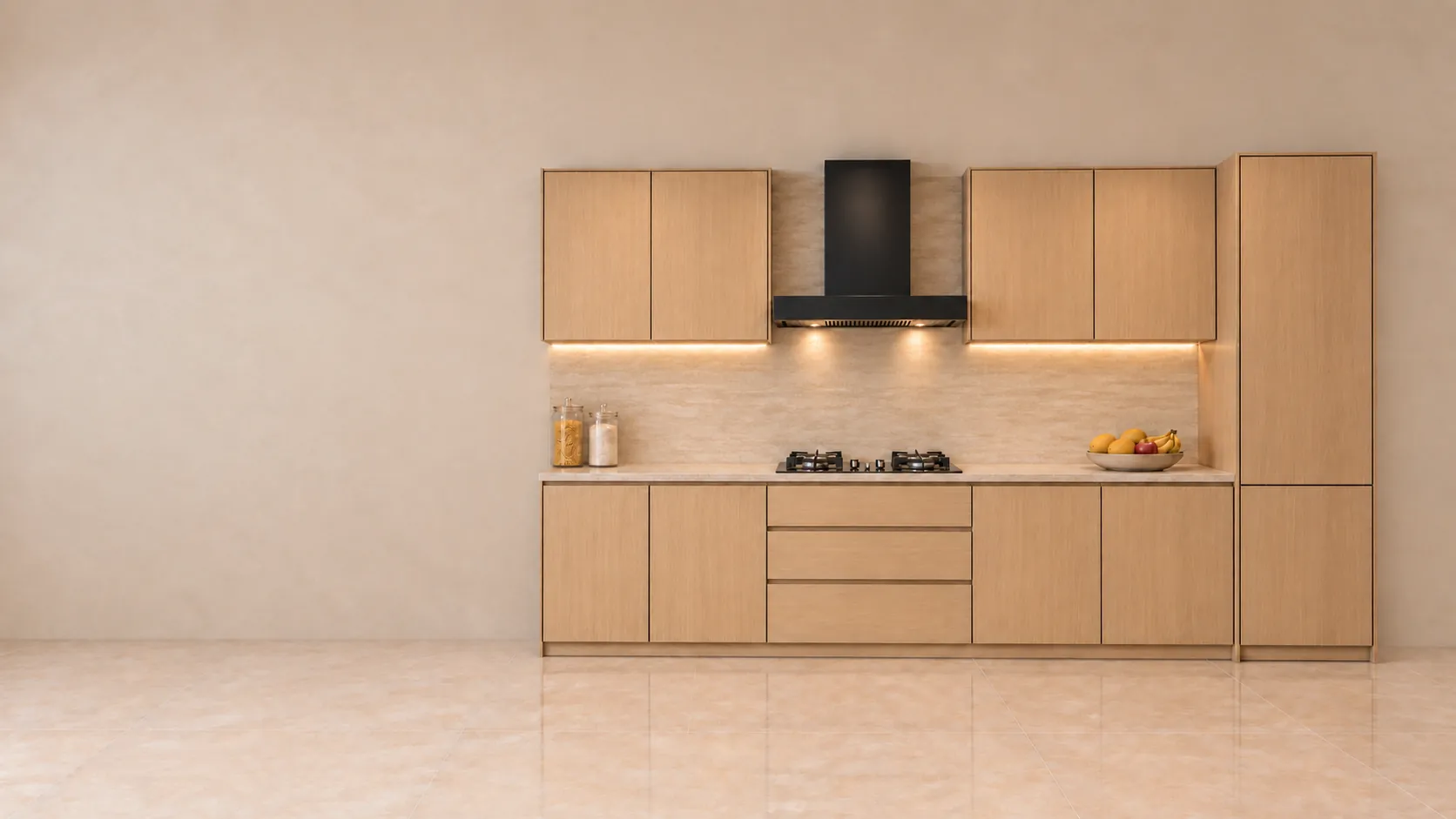
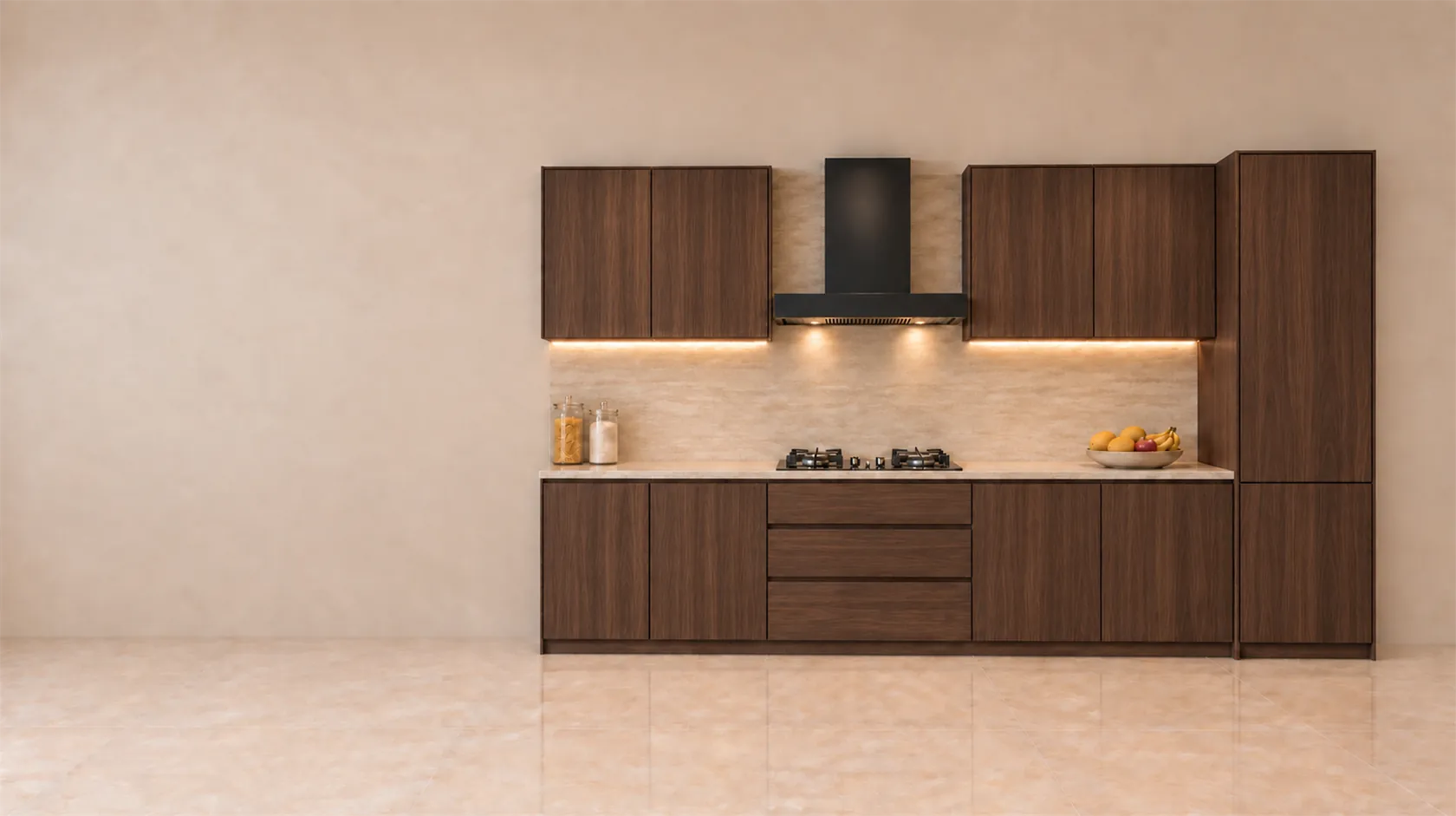 kitchen · light oak or dark walnut, swapped in the model
Questions people ask
Is acrylic more expensive than laminate?
Yes, about twice as much for the finish. In Bengaluru in mid-2026, laminate adds about ₹120 to 350 per sq ft of shutter and acrylic ₹250 to 450. A finished acrylic shutter comes to around ₹550 to 1,000 per sq ft, against ₹350 to 700 in laminate. On 80 sq ft of visible kitchen shutter, that's about ₹10,000 to 15,000 more, plus GST.
Can acrylic shutters be repaired if they get scratched?
Fine scratches polish out with an automotive polishing compound. Anything deeper stays. A badly scratched acrylic shutter gets replaced, and a replacement made a year later can be a shade off the rest. Laminate is the same. PU is the only one of the three that can be sanded and re-sprayed in place.
Do acrylic shutters fade or yellow in sunlight?
Good acrylic sheet holds its colour and doesn't yellow, which gives it an edge over paint. Good laminate doesn't fade either. The one that yellows is PU sprayed without a UV hardener: white PU on a west-facing wall can turn cream in five to eight years. In a sunny room, ask what UV protection the finish has.
Which material is best for a kitchen wardrobe?
Match it to the rest of the kitchen, on a BWP plywood or HDHMR box. A tall unit or pantry sits in the same wall as the other shutters, so it usually takes the same finish. It's also opened as often as a bedroom wardrobe, knocked by jars and bags, and stands in the same steam. So if you're still choosing a finish for the whole kitchen, that's one more reason to lean towards a matt laminate, at about half the price of acrylic.
Start with a free consultation
The first step is 45 minutes, free, online on Google Meet or in person at the Whitefield studio. You see a finished home from the inside, ask everything you want to ask, and leave knowing what your home would cost to design. Nothing to pay, nothing to sign, no proposal on the spot. Book your consultation or WhatsApp +91 96069 34051.