Laminate vs veneer: which finish, where, and what it costs in Bengaluru.
Laminate is a printed sheet pressed hard under heat. Veneer is a thin slice of real wood glued onto a board and polished. Laminate wins on price, in the kitchen and on anything a child touches; veneer wins on a main door, a dining table and a TV unit. This page gives a verdict per use, a Bengaluru price for each, and the check that matters more than the material.
The verdict, before the detail
We sell neither sheet, so the verdict is only about what each finish does on each surface over ten years.
What laminate is, and what veneer is
Laminate is paper soaked in resin with a printed sheet on top, pressed under heat into one hard sheet, glued onto plywood or MDF with the edges sealed by a matching tape. The grain you see is a photograph of wood, so it is identical from one sheet to the next. In Bengaluru it is also called mica or sunmica, after the brand that sold it first.
Veneer is real wood, sliced thinner than a millimetre and glued onto a thin backing, then onto plywood, sanded and polished, because raw veneer has no protection of its own. The grain is the tree's own, so no two sheets match. The polish is where a good part of the cost and all of the maintenance goes. It is real wood on the outside and plywood underneath, not solid wood.
Which finish where: a verdict per use
Surface by surface, for a flat in Bengaluru.
Is laminate or veneer more expensive?
Veneer is more expensive: in Bengaluru a 1 mm laminate sheet costs about ₹40 to 130 per sq ft and a 4 mm natural veneer sheet ₹70 to 350 per sq ft, and veneer then needs a polish on top, so a finished veneer shutter comes to roughly two to four times a laminate one.
Typical Bengaluru rates, mid-2026, estimates: brackets rather than quotes, and your dealer's number should sit inside them.
How can I tell if my furniture is laminate or veneer?
Look at the edge and the grain: laminate shows a thin, even plastic layer with a printed pattern that repeats from one panel to the next, and veneer shows a fine layer of wood with grain that does not repeat and open pores you can feel.
- The edge. On laminate the pattern stops at a sealed strip of tape. On veneer the edge is wood, often a strip of the same species, with the top slice showing as a fine line.
- The repeat. Stand back from three shutters, find a knot, and look for it again. Printed grain comes back in the same place on every sheet, and real grain does not repeat.
- Touch and light. Polished veneer glows unevenly along the grain and has pores your nail can feel. Laminate is flat and uniform.
Humidity and sunlight in Bengaluru: what ten years does to each
Relative humidity in Bengaluru runs around 45 to 50% in March and 75 to 80% in August, with two monsoons, so a flat goes from dry to damp and back every year. Veneer is wood, and wood moves: a shutter that was flat in March can bow a little by September if the veneer is on one face only and the polish has worn thin. A good carpenter balances both faces and seals every edge. Laminate does not care about humidity; the board underneath does, so the plywood grade matters more than the finish.
Sunlight runs the other way: a veneer next to a west-facing window changes colour in a year or two, teak darker, oak and walnut lighter, while laminate holds its printed colour. Where the afternoon sun lands, use laminate or hang a curtain.
Maintenance: a cloth versus a polisher
Laminate needs a damp cloth, mild soap for grease and nothing abrasive. When it fails it fails at the edge, where the tape lifts, and a carpenter re-glues it in an afternoon. A deep scratch cannot be repaired, only replaced.
Veneer needs a re-polish every eight to twelve years, sooner where it is handled, at ₹80 to 150 per sq ft. In return, scratches and water rings can be sanded out, which laminate can't. Spills are wiped straight away and nothing hot goes on it.
Have you seen it across the whole wardrobe?
Whether you still like your wardrobe in five years depends less on laminate versus veneer than on whether you saw the finish at full size before you paid. Both get chosen off a chip the size of a business card, under a showroom light. Then seven feet of it arrives in your bedroom, next to your wall colour and your floor, and a repeat you never noticed on the chip becomes a pattern across three shutters. We wrote up a couple who lived with exactly that for ten years.
That is what we fix. Every finish we design is a real product with a brand and a code, and we build your whole home at full size, lit the way each room is lit. You stand inside it at our Whitefield studio and see the wardrobe in that laminate or that veneer, next to your wall colour, before anything is ordered. If the grain repeats, you swap it in a minute. We take no margin or commission on materials, so your choice changes nothing for us. The master bedroom at our studio has Merino laminate wardrobes and a Mikasa veneer door, each listed with a link to buy it.
Free, 45 minutes, online on Google Meet or at the studio. Bring the laminate and veneer samples you're deciding between and we'll show you the wardrobe in each.
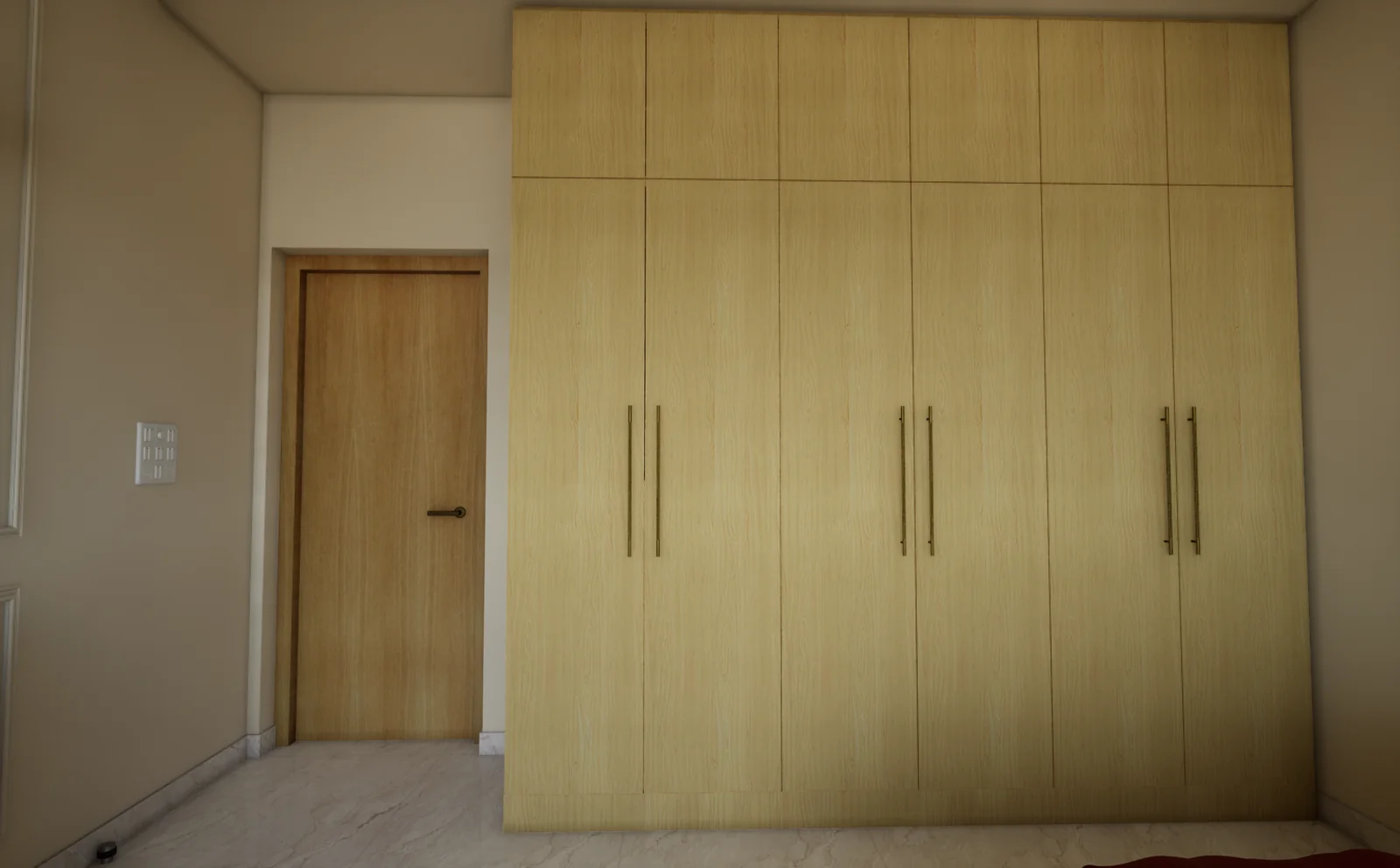 studio master bedroom · one laminate across the whole wardrobe run
Questions people ask
Is mica the same as laminate?
Yes. Mica and sunmica are what carpenters and dealers in Bengaluru call decorative laminate, after the brand that first sold it in India in the 1960s. Every sunmica sheet is a laminate; not every laminate is that brand. When a quote says mica shutters, it means laminate shutters, and you should still ask for the brand, the thickness (1 mm for shutters) and the design code, so nothing can be swapped later.
Can I use veneer in a Bengaluru kitchen?
You can, but the kitchen is the place to avoid it. Steam from the hob, oil, turmeric and a daily wet wipe dull and stain a polished wood surface within a few years, and the polish cannot be redone in a fitted kitchen without pulling the shutters off. Laminate handles all of it at a third of the price. If you want wood in the kitchen, put veneer on the open shelves or the dining side, away from the hob and the sink.
Does veneer fade in sunlight?
It changes colour rather than fades. Teak and most darker woods go darker in direct sun; oak, ash and walnut usually go lighter, and anything that stood in front of the surface leaves a pale outline. It takes a year or two next to a west-facing window. A UV-resistant polish slows it; a curtain stops it. Laminate keeps its printed colour, which is why it is the safer choice on the sunny side of a room.